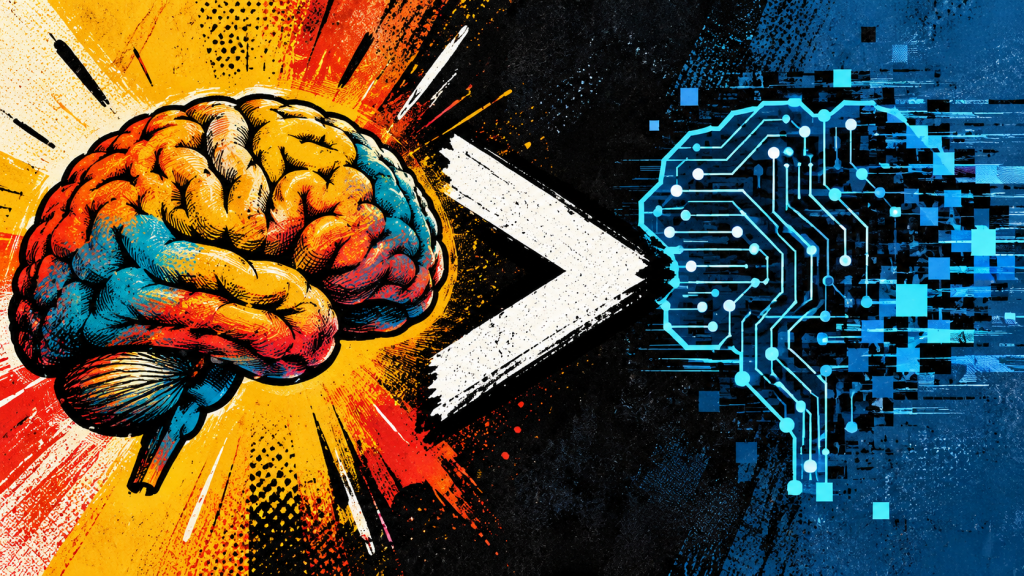
I’m a big proponent of artificial intelligence.
I use it regularly. I teach others how to use it. I believe it has enormous potential to change the way we work, learn, create, and solve problems.
But I don’t want to call it “Super Intelligence.”
The president recently announced his preference for replacing “artificial intelligence” with “super intelligence,” arguing that the word artificial makes the technology sound fake. I understand the point. There is nothing fake about what AI can do. Its capabilities are real, increasingly impressive, and advancing remarkably fast.
But I think the word artificial may be more important than ever.
Because it reminds us what this technology is—and what it isn’t.
Artificial intelligence can analyze enormous amounts of information. It can identify patterns we might miss. It can generate ideas, write code, create images, summarize research, and help us think through complicated problems.
In some specific tasks, it can already outperform us.
But does that make it better than us?
That is where I struggle with the word “super.”
AI isn’t alive. It doesn’t feel joy, fear, grief, love, pride, or regret. It doesn’t have children to worry about or parents to care for. It doesn’t wake up wondering whether it made the right decision yesterday. It doesn’t have values unless we give it instructions intended to reflect ours.
It can generate an opinion. That doesn’t mean it has one.
That distinction matters.
Calling AI “Super Intelligence” subtly changes the relationship between humans and the technology we created. “Super” suggests something above us. Something more capable. Perhaps eventually something we should defer to.
And I’m not convinced that is a healthy way to think about AI.
The more capable these systems become, the more important I believe human judgment becomes—not less important.
We should absolutely use AI to help us make decisions. Let it analyze the data. Let it challenge our assumptions. Let it find connections we missed. Let it present possibilities we hadn’t considered.
Then a human being should make the decision.
That is especially important as AI moves into consequential areas of our lives: employment, education, finance, healthcare, government, insurance, and countless others.
Efficiency cannot be our only measure of intelligence.
Neither can processing speed, memory, or access to information.
There are things humans bring to decisions that are extraordinarily difficult to quantify: empathy, experience, context, morality, accountability, and an understanding of what it actually means to live with the consequences.
Maybe someday AI will convincingly simulate all of those things.
But simulation and humanity are not the same thing.
This isn’t an argument against AI. Quite the opposite. I believe AI may be one of the most powerful tools human beings have ever created.
And that is exactly why I think the language matters.
I want us to become better at using artificial intelligence, not become accustomed to surrendering our own intelligence to it.
Keep humans in the loop.
Keep humans accountable.
Keep humans making the decisions.
And keep the word artificial.
It reminds us that no matter how remarkable the technology becomes, it is still a tool created by people.
The intelligence may be artificial.
The responsibility is not.
Disclosure: I use AI as a tool to help refine, revise, and challenge my writing. The ideas, arguments, and opinions expressed here are my own.


Leave a Reply